
On Thursday, congressional Republicans pushed through Trump’s 1,000-page budget, and he signed it on Saturday. The wealthy will become even richer. The poor will face greater hunger and illness, more unstable jobs, and an increasingly hotter planet. The symmetry is brutal: cuts to healthcare and food programs will slash about $120bn a year over the next decade—the same amount households earning more than $500,000 will save in tax cuts each year.
Trump achieved exactly what he set out to do. Enriching himself and his elite circle at the expense of everyone else has always been his mission. But only once he reached the presidency—with the Heritage Foundation’s think-tankers, deportation architect Stephen Miller, and six unwavering Supreme Court allies at his side—could he mold America into a reflection of his own amoral, racist, violence-thirsty ideology. In truth, that mission may matter even more to him than accumulating wealth.
Ice has become Trump’s private militia. It must be abolished
This Article Includes
The night before the Senate vote, JD Vance made the administration’s priorities crystal clear. “Everything else,” including the Congressional Budget Office’s deficit projections and “the minutiae of the Medicaid policy,” he posted, “is immaterial compared to the ICE money and immigration enforcement provisions.”
The vice-president’s blatant disregard for millions of American lives—especially those from the working-class community he claims to represent—infuriated Democrats and the left. But his comment also spotlighted a massive appropriation buried in the budget. Leah Greenberg, co-chair of the progressive activist group Indivisible, tweeted, “They are just coming right out and saying they want an exponential increase in $$$ so they can build their own personal Gestapo.”
While the media focused on how the budget widens the wealth gap into something like the San Andreas fault, they also reported a record-breaking $1.3tn in military funding and vague increases for “border security.”
Even if we set aside the loaded implication that America faces an invasion—which it does not—the term still fails to describe what’s unfolding. This budget funds a federal police force whose authority will stretch far beyond immigration. Its reach aims higher than removing nearly 48 million immigrants —including the three-quarters who are legal residents, green-card holders, or on temporary visas.
This massive expansion of Immigration and Customs Enforcement (ICE) is set to make it the largest domestic police force in the country. With more resources than all federal surveillance and incarceration agencies combined, ICE will outsize the FBI in agents. It will grow bigger than the militaries of many nations. Once ICE exhausts its list of immigrants to deport, it—under its current name or a rebranded one—will retain the power to surveil, detain, and disappear anyone labeled a threat. No future president is likely to dismantle such an institution.
ICE will get $45bn for immigrant detention over four years—more than what the Obama, Biden, and first Trump administrations spent combined. The agency plans for 100,000 detention beds. But with $16.5bn in loosely defined “enforcement” grants going to states, the American Immigration Council estimates capacity could expand to 125,000—approaching the total population of federal prisons.
From a $170bn pool, the Department of Homeland Security plans to hire 10,000 new ICE agents, pushing the force to 30,000, alongside 8,500 new border patrol agents. By comparison, the FBI employs about 23,700 people, including 10,000 special agents.
DHS’s budget is loaded with duplication: $12bn to DHS for border and immigration enforcement, $12bn to Customs and Border Protection for staffing, vehicles, and tech, plus $6.2bn for more tech. And topping it all, over $45bn is earmarked to complete Trump’s “beautiful” border wall—on top of the $10bn spent during his first term for a project he promised would cost under $12bn and be paid for by Mexico.
As ICE deports children, what futures do we lose?
To offset the costs of its crackdown, the government plans to extract revenue from its targets. The cruelty baked into the fees almost feels incidental. According to a New York Times breakdown, a refugee must pay $500 or $1,000 for temporary legal status, depending on whether they’re escaping war or humanitarian disaster. There’s now a $250 application fee for a visa for children abused, abandoned, or neglected by their parents.
Immigrants must pay up to $1,500 for status adjustments ordered by a judge. If ICE arrests them after they miss a hearing under a judge’s removal order, they’re charged $5,000. The budget doesn’t clarify if there’s a fee for showing up at court and getting detained anyway—which ICE now frequently does.
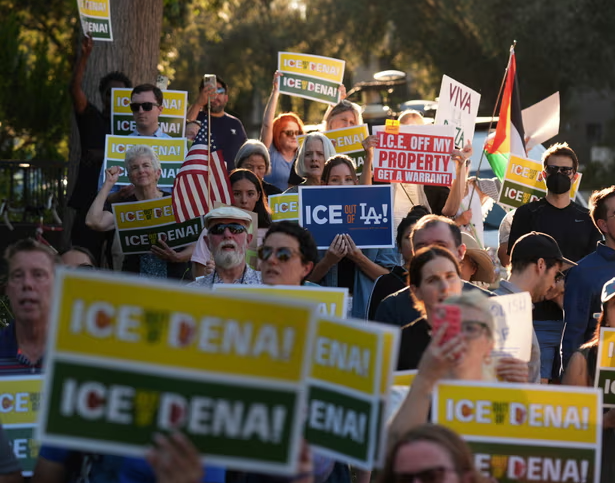
From a bird’s-eye view, a vast, increasingly cohesive police state is coming into focus. The lines between federal and local, military and civilian law enforcement, are blurring fast. During anti-ICE protests in Los Angeles, Trump federalized the National Guard to suppress a nonexistent uprising—and an appeals court upheld it. Despite the Posse Comitatus Act forbidding the military from enforcing civilian law, marines detained a US citizen. To skirt the law against using the military for immigration enforcement, Trump declared an “invasion” at the southern border. The Pentagon then claimed more territory. Last week, it annexed 140 miles of land to a marine air station in Arizona and announced plans to take 250 more in Texas under the Air Force. Historian Heather Cox Richardson reports that Governor Ron DeSantis deployed the National Guard to “Alligator Alcatraz,” a new immigrant detention center in the Florida Everglades. Two hundred marines have been sent to Florida to assist ICE, and agents will soon be stationed at marine bases in California, Virginia, and Hawaii. The military budget includes $1bn for “border security.”
A budget is a numerical expression of values. This one funnels wealth upward while funding a sprawling police state. These goals connect through more than just profits made from building and operating the infrastructure. When people go without food, medicine, and shelter—when public life crumbles and families lose hope—crime and unrest follow. When that happens, the state will unleash its police forces—ICE, marines, local law enforcement, or private security—to suppress the anger and shield the elites’ assets from the growing desperation of the public.